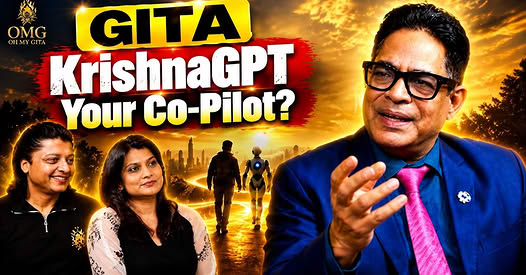
From the Bhagavad Gita to Artificial Intelligence: Dr. Suborno Bose on Preparing Students for the Future
In an episode of OMG – Oh My Gita, the Founder of IIHM connects ancient wisdom with modern challenges, offering students a practical perspective on career choices, AI, resilience, ethical leadership and the human values that will shape the future of hospitality.
What does the Bhagavad Gita have to teach a hospitality student preparing for a career in a world transformed by artificial intelligence? How should young people respond when their career plans change, when failure disrupts their ambitions, or when technology begins to reshape the jobs they hope to pursue?
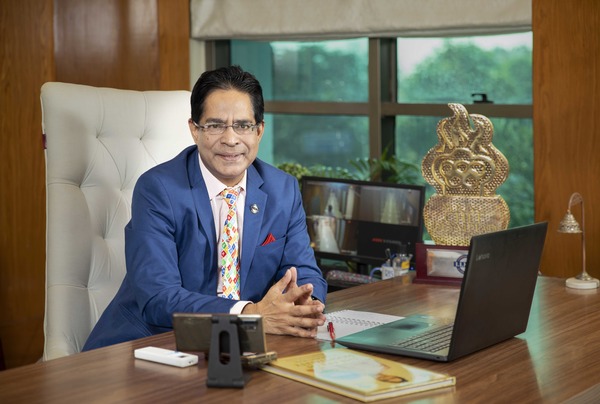
These questions take centre stage when Dr. Suborno Bose, Founder-Director of the International Institute of Hotel Management (IIHM), joins OMG – Oh My Gita, a curiosity-driven podcast exploring the relevance of the Bhagavad Gita in contemporary life.
The conversation moves beyond conventional discussions of spirituality. It brings together education, entrepreneurship, hospitality, artificial intelligence and personal growth, offering valuable lessons for students who are preparing not just for their first jobs, but for a lifetime of learning and leadership.
For IIHM students, the central message is particularly relevant: technology may change the way we work, but human intelligence, empathy, ethical judgement and the willingness to keep learning will continue to define our professional worth.
Finding Your Calling: Why Your Career Path Need Not Be Straight
Dr. Bose’s own journey offers an important lesson in discovering one’s professional purpose.
He began his career as a Chartered Accountant, but his experience of teaching evening classes at the Institute of Chartered Accountants of India revealed a different calling. Teaching proved both personally and financially fulfilling, eventually leading him to establish IAM in 1989. His subsequent engagement with hospitality education paved the way for IIHM in 1994.
Reflecting on this journey through the Bhagavad Gita’s concept of Swadharma, or one’s individual calling and responsibilities, Dr. Bose explains that people must be willing to pause and change direction when they realise they are not on the right path.
For students, this is a powerful reminder that choosing a career is not simply about following trends, meeting expectations or pursuing what appears successful from the outside. It is also about recognising one’s interests, abilities and sense of purpose.
A student who enjoys working with people, solving problems, creating memorable experiences or experimenting with food may discover that hospitality offers opportunities that extend far beyond the traditional image of hotel work.
The important question is not whether your career journey follows a predetermined route. It is whether you remain curious enough to discover where your strengths can make a meaningful difference.
AI is Changing Hospitality. Are You Ready to Work With It?
Artificial intelligence is already changing how people search, learn, communicate and make decisions. In hospitality, its applications range from online bookings and digital check-ins to personalised guest services, connected room controls and data-assisted decision-making.
Dr. Bose believes that the pace of change is so rapid that developments once expected over five years may arrive within weeks. For students, waiting until they enter the workplace to understand AI is therefore not a practical option.
His message is direct: AI will displace those who refuse to adapt, while empowering those who learn to use it effectively.
However, understanding AI requires much more than knowing how to enter a prompt into ChatGPT. Genuine AI literacy involves learning how tools work, evaluating the accuracy of their outputs, asking better questions, protecting information and recognising their limitations.
Imagine a hospitality student preparing a restaurant concept. AI could help generate menu ideas, estimate nutritional values, explore food pairings or suggest creative plating possibilities. A student preparing for an interview could use it to practise questions, improve communication and identify gaps in their knowledge.
Yet the student must still taste the food, understand the guest, evaluate the suggestions and make the final decision.
As Dr. Bose explains, AI should function as an assistant or co-pilot, with the human remaining the pilot.
This principle reflects an important direction for contemporary hospitality education: students must learn to combine technological competence with practical expertise, critical thinking and human judgement.
The Human Touch: Hospitality’s Most Valuable Strength
Hospitality is built around people. Guests may appreciate a seamless digital booking experience, but their overall impression of a hotel or restaurant is also shaped by how they are welcomed, understood and cared for.
Dr. Bose emphasises that AI cannot replicate the emotional warmth, care and human connection that define empathetic professions. Technology can assist a chef with recipe development or a hospitality professional with service planning, but it cannot replace the responsibility to understand and respond to another person’s needs.
For IIHM students, this distinction is central to professional development.
A hotel guest arriving after a delayed flight may need more than an efficient check-in. A restaurant guest celebrating a special occasion may remember the attentiveness of a server long after forgetting the details of the meal. A team member facing a difficult shift may need a leader who listens rather than simply monitors performance.
These situations call for emotional intelligence, communication, observation and sound judgement.
The future hospitality professional will therefore need to be comfortable with both technology and human interaction. Digital skills can improve efficiency, but empathy helps turn a service transaction into a memorable experience.
The goal is not to choose between technology and the human touch. It is to use technology in ways that make hospitality more thoughtful, responsive and personal.
Failure Is Not the End of the Journey
In a generation accustomed to quick results, setbacks can feel particularly difficult. Students may compare their progress with that of their peers, worry about placements or become discouraged when an idea does not work as expected.
Dr. Bose’s entrepreneurial journey offers a different perspective.
He recalls an ambitious pre-COVID project developed in partnership with IBM to create a predictive career-assessment algorithm for students in Classes 10 and 12. The project was ahead of its time, faced limitations because it had been designed for laptops rather than mobile phones, and struggled to find customers willing to pay for testing.
Although the initiative proved expensive, it became a valuable research and development experience.
Connecting this experience with the Bhagavad Gita’s principle of Samatva, or equanimity in success and failure, Dr. Bose underlines the importance of resilience. Failure, in his view, is an essential part of the process of achieving success.
For students, this does not mean ignoring mistakes or treating every outcome as equally satisfactory. It means learning to respond constructively rather than allowing disappointment to become a permanent barrier.
A failed practical assessment can reveal where more practice is needed. An unsuccessful interview can help identify gaps in preparation. A rejected business idea can lead to a better understanding of customer expectations.
In hospitality, where professionals must adapt quickly to changing circumstances, the ability to learn from experience is as important as technical knowledge.
The lesson is simple: take responsibility for the outcome, learn from what went wrong and keep moving forward.
Beyond the Classroom: Learning Must Keep Pace With Industry
One of Dr. Bose’s strongest observations concerns the relationship between education and the workplace.
He argues that academia must remain connected to real-time industry practices rather than depend on textbooks that may no longer reflect current realities. Hospitality education, he believes, must evolve continuously, incorporating developments such as AI, digital marketing and sustainability.
This is particularly relevant to IIHM, where students prepare for an industry shaped by changing guest expectations, new technologies and global service standards.
A student cannot become industry-ready through theoretical knowledge alone. Understanding food production, front office operations, housekeeping, food and beverage service and hospitality management must be supported by practical application, teamwork, communication and problem-solving.
Equally, learning cannot end with a qualification. Professionals must continue to update their skills as new tools, business models and customer expectations emerge.
Dr. Bose also highlights a responsibility on the industry’s part: hospitality businesses must nurture young talent rather than create working environments that drive people towards other sectors.
This makes the transition from student to professional a shared responsibility. Educational institutions must prepare students for the realities of work, while employers must create environments in which young professionals can grow, contribute and build lasting careers.
The Young Chef Olympiad: Skills With a Larger Purpose
Dr. Bose’s vision of education extends beyond individual career success. His experience of building the Young Chef Olympiad (YCO), launched in 2015, illustrates how hospitality can become a platform for cultural exchange, international collaboration and lifelong professional relationships.
The initiative brings young culinary talent together, creating opportunities for students to interact with international chefs and judges, exchange ideas and develop global networks.
IIHM students also take an active role in managing the event. Their responsibilities allow them to experience the demands of coordinating an international platform while engaging with professionals from different culinary and cultural backgrounds.
For students, this is learning in action. They develop organisational skills, confidence, teamwork and an understanding of how hospitality brings people together across borders.
Dr. Bose connects this larger purpose with Loka-Samgraha—the idea of working for the welfare and cohesion of society.
The same philosophy is reflected in Food Soldiers, an IIHM student initiative inspired by the Robin Hood Army and focused on addressing food waste and hunger. As described in the podcast, around 8,000 IIHM students across 18 campuses participate in this ongoing initiative.
These experiences reinforce an important principle: professional success becomes more meaningful when it contributes to something beyond personal achievement.
Whether through culinary exchange, food redistribution or responsible hospitality practices, students can use their skills to create a positive impact on the communities around them.
Ethics in the Age of AI: Intelligence Must Come With Responsibility
The growing influence of AI also raises questions about authenticity, privacy and responsible decision-making.
Dr. Bose warns against overdependence on technology and highlights the dangers of deepfakes, voice cloning and other forms of digital misuse. He stresses the importance of technical safeguards and early education in ethics, arguing that human intellect and moral values must guide AI rather than allow AI to dictate human choices.
For students, responsible AI use begins with everyday decisions.
It means verifying information instead of accepting every generated answer, protecting confidential information, respecting intellectual property and being transparent when AI assistance needs to be disclosed. It also means developing independent reasoning rather than allowing technology to do all the thinking.
In hospitality, these responsibilities can have direct consequences. Guest information must be handled carefully, recommendations should be evaluated fairly, and technology should support rather than undermine trust.
AI literacy, therefore, must include ethical literacy. Knowing what a tool can do is only one part of being prepared to use it professionally.
Preparing for Leadership, Not Just a First Job
One of the most important takeaways from the conversation is that hospitality education should prepare students for leadership, not merely employment.
A hospitality qualification can open doors to careers across hotels, restaurants, aviation, healthcare, media, banking, events and other service-oriented industries. The underlying skills—communication, operations, customer understanding, teamwork and decision-making—have relevance across sectors.
Research and development also have a place in the future of hospitality. Students who question existing practices, experiment with solutions and understand emerging technologies can contribute to innovation throughout their careers.
Sustainability is equally important. Responsible resource use, reducing food waste and improving operational efficiency can support both environmental goals and business performance.
For students, leadership begins well before they receive a managerial title. It develops through taking ownership of a task, supporting a team, responding calmly under pressure and making decisions with integrity.
These are the habits that transform technical competence into professional maturity.
The IIHM Way: Combining Knowledge, Technology and Human Values
Dr. Suborno Bose’s conversation on OMG – Oh My Gita brings together ideas that are especially relevant to the next generation of hospitality professionals: discover your calling, remain adaptable, learn from failure, embrace technology and preserve the human values that give your work meaning.
For IIHM students, these are not abstract lessons. They can be practised in the kitchen, during service, while organising an event, through industry exposure and in everyday interactions with peers, faculty and guests.
The Bhagavad Gita offers a useful framework for thinking about purpose, resilience and responsibility, while modern hospitality education provides opportunities to put these principles into practice.
As AI reshapes the workplace, the students best prepared for the future will not necessarily be those who use the most technology. They will be those who know when to use it, how to question it and why human judgement must remain at the centre of every important decision.
The future belongs to professionals who combine competence with compassion, ambition with responsibility and innovation with integrity.
At IIHM, preparing for that future means learning not only how to succeed in the hospitality industry, but also how to contribute to it—and to society—with purpose.